
 ES
ES  EN
EN  AR
AR  RU
RU 
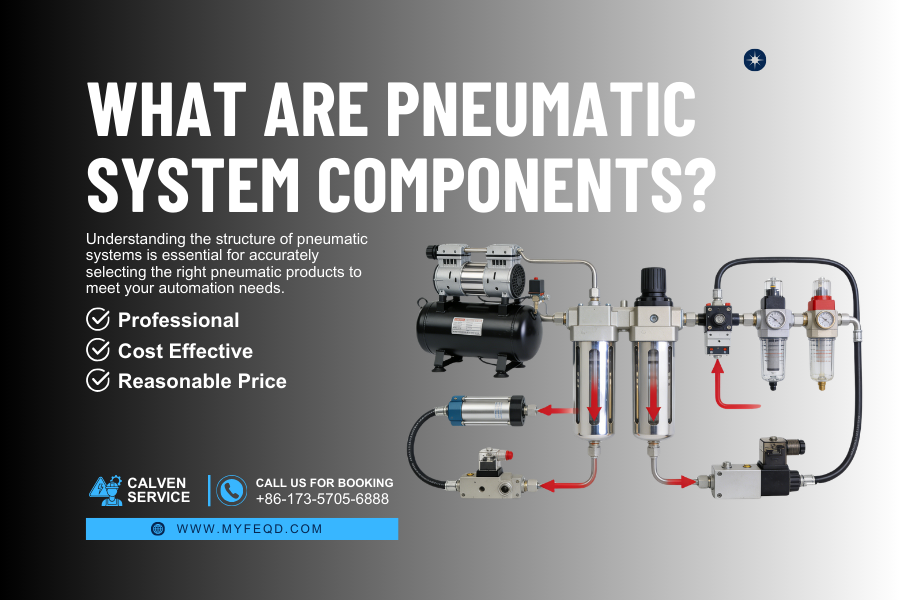
What is pneumatic system components?
Before introducing pneumatic system components, let’s first discuss what a pneumatic system is. Pneumatic systems feature simple structures, easy maintenance, strong anti-interference capability, and greater safety compared to other mechanical transmission systems. They operate on the principle of utilizing compressed air pressure to generate mechanical motion, thereby saving energy, reducing resource consumption and manufacturing costs, and being environmentally friendly. They play a crucial role in industrial automation.
A complete pneumatic system mainly consists of the following categories: air supply and conditioning equipment, control components, actuators, auxiliary components, and compressed air storage devices.
Each category plays a vital role, working together to convert the energy of compressed air into precise control and powerful mechanical motion.
The following details the pneumatic components that make up a pneumatic system.
Air source treatment
The starting point of a pneumatic system is the air preparation unit (or FRL unit), which is responsible for supplying the system with clean, dry, and stable compressed air. It consists of the following equipment and components:
- Air compressor: Compresses ambient air to generate the pneumatic power supply.
- Air dryer: Removes moisture from the compressed air.
- Air receiver: Stores compressed air and stabilizes system pressure.
4.FRL unit (Filter-Regulator-Lubricator): Comprises a filter (removes particulate contaminants).
a pressure regulator (adjusts and stabilizes air pressure), and a lubricator (provides oil mist for lubrication of downstream components).
This air preparation system is the cornerstone of reliable operation and effectively extends the service life of downstream pneumatic equipment.
pneumatic executing component
1. Pneumatic cylinders: Used to achieve reciprocating linear motion, they are available in various types depending on their function, including standard cylinders, compact (thin) cylinders, rodless cylinders, rotary actuators, mini cylinders, lever cylinders, dual-rod cylinders, three-rod cylinders, pneumatic grippers, and guided slide units.
2. Pneumatic tools: Examples include pneumatic motors, pneumatic scissors, pneumatic screwdrivers, pneumatic drills, pneumatic polishers, air blow guns, and pneumatic wrenches.
3. Cylinder accessories:
- Magnetic position sensor (reed switch):A sensor used to detect the piston position, monitor system status, and enable feedback control.
- Mounting accessories:Used to secure the cylinder in position, including brackets, foot mounts, and flange mounts.
- Floating joint and clevis joint:Used to compensate for misalignment and ensure smooth transmission of force and motion.
pneumatic control components
Control components are the “brain” that directs the actions of the actuators.
1. Directional control valve: Controls the flow path direction and switching of compressed air (e.g., 5/2-way, 3/2-way solenoid valves).
2. Flow control valve: Regulates the speed of actuators by adjusting the airflow rate (e.g., throttle valves, flow regulators).
3. Pressure control valve: Regulates, limits, or maintains system pressure (e.g., pressure regulators, sequence valves).
4. On/off valve: Simply opens or blocks the airflow for isolation purposes (e.g., ball valves, shut-off valves).
5. Safety valve: Opens automatically to vent excess pressure when the system pressure exceeds the safe limit, protecting downstream components.
Pneumatic auxiliary component
Pneumatic systems rely on various auxiliary components to connect the air source, actuators, and control elements. These include:
1. Connectors and tubing: Used to connect components and supply air. Fittings include: push-in fittings (brass, stainless steel, mini sizes), threaded fittings (G-thread, NPT), compression fittings, rotary unions, and reducing adapters. Tubing includes: PU (polyurethane), PA (polyamide/nylon), soft nylon, and recoil (spiral) tubing.
2. Silencers: Installed at valve exhaust ports to reduce noise. Examples include: sintered bronze silencers, plastic body silencers, and exhaust mufflers.
3. Manifolds: Used to distribute airflow to multiple valves or actuators, simplifying installation and reducing leak points. Examples include: valve manifolds (base plates) and air distribution blocks.
Summarize
A thorough understanding of these component classifications and functions is the foundation for designing, installing, and maintaining efficient and stable pneumatic systems. With over 15 years of specialization in pneumatic components, (MYFEQD) Wenzhou mai feng Pneumatic Co., Ltd. delivers competitive pricing, exceptional product quality, and dependable technical support to meet your automation needs.

