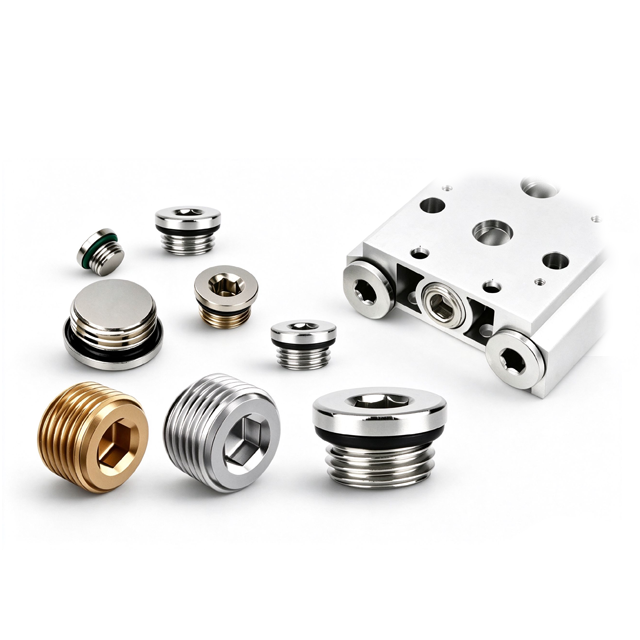
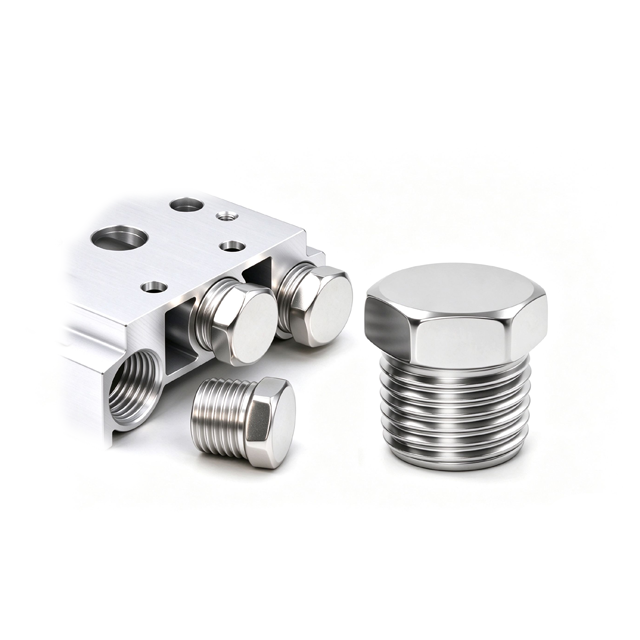
Manifold Plug is a sealing fitting for pneumatic systems. It is screwed by its external thread into an unused threaded hole and seals through the end face or tapered surface to close the air path and block off unused outlet / inlet ports. It is available in brass, steel and 304 stainless steel, and in socket head (tightened with an Allen / hex key), hex head (tightened with an open-end wrench) and small socket head types.
The external thread (G / PT) of the plug is screwed into the internal threaded hole: a tapered thread seals by compression on the tapered thread surface, while a flat-end plug seals together with a sealing ring. Once tightened, it isolates the internal and external air paths so compressed air cannot leak from the port. Socket-head types use an Allen wrench and hex-head types an open-end wrench.
Характеристики
Blocks redundant threaded holes to prevent air leakage; unified specifications match the threads of pneumatic components; different materials suit dry, damp, corrosive and export equipment; the small socket head is dedicated to narrow mounting spaces; the hex head suits high-torque wrench tightening.
For reserved threaded holes in an air path that need no air supply after commissioning, and for blocking to prevent leakage and dust. Choose the material by working condition: steel for low-cost dry use; brass for rust prevention on ordinary export equipment; 304 stainless steel for damp / salt-spray / copper-free conditions; the small socket head for narrow spaces; and the hex head for high-torque tightening.
Широкий спектр применения
Automation equipment factories, pneumatic integrators, manifold block manufacturers, solenoid valve assembly plants, foreign trade pneumatic traders, machine tools and packaging machinery manufacturers.
Redundant holes in solenoid valve manifold blocks, spare threaded ports of cylinders, extra ports of filter regulators, unused threaded holes of pneumatic fittings, and reserved holes in air circuit boards.