1. Weld Spatter Protection: Features a stainless steel scraper ring on the front cover—replacing standard dust boots—to block weld spatter and dust, making it suitable for harsh arc and spot welding environments.
2. Toggle-Action Force Amplification: Operates at 0.3–0.8 MPa; amplifies clamping force at the dead-center position, ideal for clamping in sheet metal welding applications.
3. Versatile Clamp Arms: Available in AM1/AM2/AM3/AM4 specifications, supporting L, C, and R offset configurations with selectable opening angles ranging from 15° to 120°.
20 lat doświadczenia w branży produkcyjnej – dostarczamy rozwiązania dostosowane do Państwa konkretnych specyfikacji i wymagań produkcyjnych.
Ponad 20 lat doświadczeniaJakość naszych produktów dorównuje jakości produktów największych marek, ponieważ ściśle przestrzegamy norm technicznych wiodących marek krajowych i międzynarodowych.
Jakość zgodna z normami ISONasza firma, z siedzibą w Liushi w mieście Yueqing, w regionie Wenzhou, w prowincji Zhejiang w Chinach, może pochwalić się kompleksowym łańcuchem dostaw komponentów, zaawansowanym, wysokiej klasy sprzętem oraz wieloletnią tradycją produkcyjną.
Ceny bezpośrednio od producentaWelding clamping cylinders—also known as heavy-duty clamping cylinders—are specifically designed for automotive sheet metal welding fixtures.
Utilizing a crank-toggle force-amplification mechanism,
they generate high clamping force from low air pressure and serve as specialized clamping actuators for welding assembly lines.
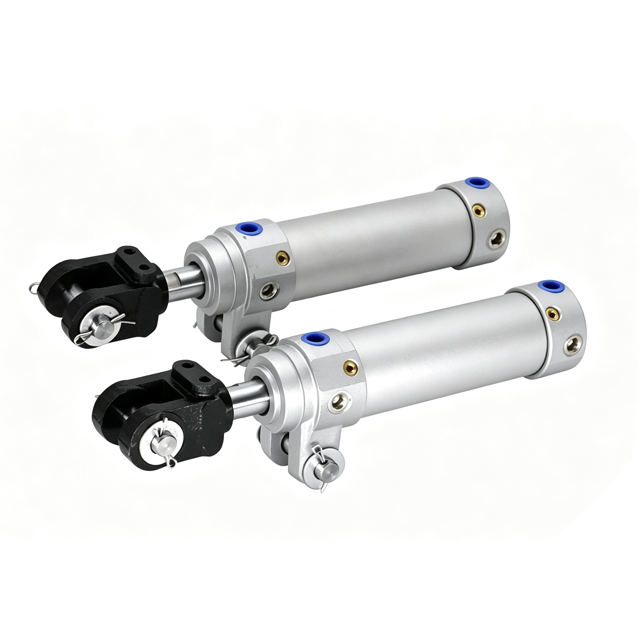
1. Suitable for automotive welding shop environments;
2. The front cover features a durable stainless steel dust seal that protects the cylinder from damage caused by dust and welding spatter—a more reliable solution than a dust boot;
3. Interference-resistant sensors should be selected for use in strong magnetic field environments;
4. Air intake ports are available on three sides; includes built-in cushioning and speed-limiting adjustments;
5. A wide range of sensor options is available.
| Średnica otworu (średnica wewnętrzna w mm) | 40 | 50 | 63 | 80 |
|---|---|---|---|---|
| Rodzaj działania | Dwustronnego działania | |||
| Środek roboczy | Powietrze (przefiltrowane przez filtr o wielkości porów 40 μm lub większej) | |||
| Temperatura robocza | od -20°C do +70°C | |||
| Zakres ciśnienia roboczego | 0,15–1,0 MPa | |||
| Ciśnienie próbne | 1,5 MPa | |||
| Zakres prędkości roboczej | 50–500 mm/s | |||
| Amortyzacja | Rear-end air cushion + Front-end air cushion | |||
| Flow Control Valve | Standard at both front & rear | |||
| Mounting Type | Double Clevis | |||
| Średnica zewnętrzna tłoczyska (mm) | 20 | 20 | 20 | 25 |
| Wątek dotyczący portu | PT1/4 | PT3/8 | ||
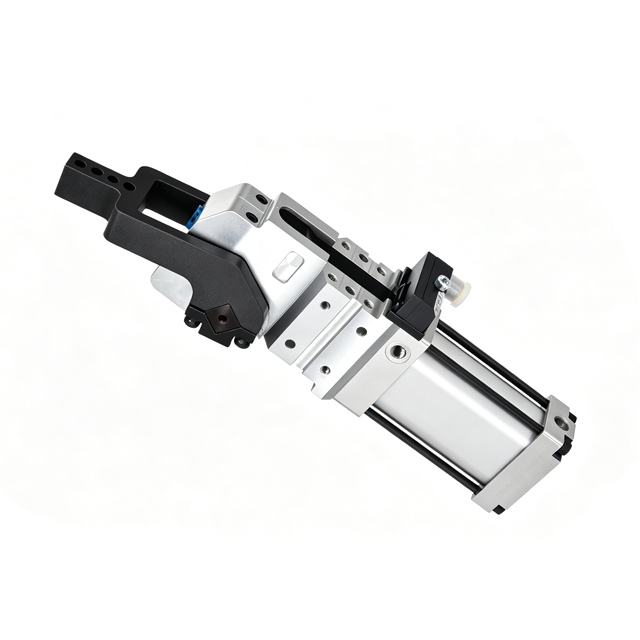
1. Various clamping arm specifications available
2. Crank-slider mechanism
3. Multi-directional mounting
4. Integrated design
5. Various sensor options available
| Średnica otworu (średnica wewnętrzna w mm) | 40 | 50 | 63 | 80 |
|---|---|---|---|---|
| Rodzaj działania | Dwustronnego działania | |||
| Środek roboczy | Powietrze (przefiltrowane przez filtr o wielkości porów 40 μm lub większej) | |||
| Temperatura robocza | od -20°C do +70°C | |||
| Zakres ciśnienia roboczego | 0.3~0.8MPa | |||
| Ciśnienie próbne | 1,2 MPa | |||
| Max Opening Angle (Horizontal Arm) | AM1: 135° AM3: 105° | AM1: 135°, AM2: 135°, AM3: 135°, AM4: 135° | ||
| Max Opening Angle (Vertical Arm) | AM1: 120° AM3: 105° | AM1: 105°, AM2: 105°, AM3: 105°, AM4: 105° | ||
| Min. Open/Close Time | 1 second to clamp, 1 second to open | |||
| Amortyzacja | Air Cushion | |||
| Position Sensing | Inductive Proximity Sensor | |||
| Wątek dotyczący portu | PT1/8 | PT1/4 | PT1/4 | PT1/4 |
| Nie. | Seria | Typ | Najważniejsze cechy | Wymiana krzyżowa |
|---|---|---|---|---|
| Welding Clamp Cylinder (Domestic / Airtac) | ||||
| 01 | MCK | Welding clamp / compound | Airtac welding clamp cylinder; purpose-built for automotive welding lines; stainless steel front-cover wiper resists spatter (more reliable than rubber boots); 3-side porting; built-in cushion + flow control; magnetic-field-resistant sensor option; bore 25–80 | ↔ JSK, CK1A |
| 02 | JSK | Welding clamp | Welding-fixture clamp cylinder; spatter-resistant construction; same class as MCK; for body-in-white welding fixture clamping | ↔ MCK, CK1A |
| Festo Hinge Clamp (Asian Auto Body Standard) | ||||
| 03 | DWA | Hinge clamp cylinder | Festo hinge cylinder for clamping parts during welding; swivel bearing on bearing cap for easy mounting; integrated flow control and end-position cushioning; rod wiper seal against spatter; Asian automotive body-production standard | ↔ DWB, DWC |
| 04 | DWB | Hinge clamp cylinder | Festo DW-series hinge clamp; same spatter-resistant design; integrated cushion; for body welding fixtures | ↔ DWA, DWC |
| 05 | DWC | Hinge clamp cylinder | Festo DW-series hinge clamp; different mounting / stroke variant; spatter-resistant; for automotive welding stations | ↔ DWA, DWB |
| SMC Welding-Specific | ||||
| 06 | CK1A | Welding clamp / clevis | SMC clamp cylinder for auto welding; clevis width 16.5 mm; built-in speed controller; air cushion; magnetic-field-resistant auto switches for strong-magnet environments; bore 40/50/63; mainstay of automotive welding lines | ↔ MCK, JSK |
| 07 | CA1B | Spatter-resistant standard cylinder | SMC CA2 XC88/XC89/XC91 spatter-resistant variant; fluoropolymer end covers + stainless piston rod; resists arc-welding spatter; for general linear drive in arc-welding stations | ↔ DWC (anti-spatter standard) |
Nazwy marek wymienione na tej stronie internetowej zostały podane wyłącznie w celach informacyjnych dotyczących norm technicznych. Produkt ten nie jest oryginalnym produktem danej marki i nie jest przez nią autoryzowany. Został wyprodukowany zgodnie ze specyfikacjami technicznymi danej marki i ma podobny wygląd; jest to jednak produkt opracowany niezależnie i nie ma żadnego związku z daną marką.
Automotive body-in-white welding tooling;
sheet metal spot welding and arc welding fixtures; automated welding and assembly lines;
rapid clamping and positioning for welding tooling.
Podajnik worków, głowica zgrzewająca, zasuwa leja, urządzenie do składania klap kartonowych, popychacz wyładowczy
Ustawianie i mocowanie elementów obrabianych, mechanizmy podnoszące służące do załadunku i rozładunku, mechanizmy zatrzymujące oraz wciskanie elementów.
Ustawianie uchwytów spawalniczych, mocowanie obrabianych elementów oraz przenoszenie podzespołów
Urządzenia zatrzymujące na linii montażowej, popychacze sortujące oraz urządzenia do podnoszenia palet.
Otwieranie i zamykanie drzwi obrabiarki, podawanie obrabianego elementu oraz wyrzucanie odpadów.
Płytka prowadząca przenośnika, proste urządzenie dociskowe (dostępna wersja ze stali nierdzewnej do środowisk wilgotnych)
MYFEQD oferuje szeroki asortyment Clamping Cylinder rozwiązania.
Nasze siłowniki pneumatyczne są zgodne z normami technicznymi wiodących światowych marek,
zapewnianie szybkich rozwiązań w zakresie doboru modeli w różnych gałęziach przemysłu
układy pneumatyczne.
Air drives the piston; a crank linkage swings the arm down to press the workpiece and pass over the dead center to self-lock.
It must hold under vibration, spatter, heat and air loss, which ordinary cylinders cannot ensure.
At full clamp, the linkage crosses the mechanical dead center, so the structure carries the force without relying on air pressure.
Self-lock types stay clamped; non-self-lock direct-push types release—check this when selecting.
A crank-slider (toggle) mechanism amplifies piston linear force into high arm clamping force.
Near the dead center, the toggle has very high mechanical gain, multiplying air thrust.
Heat and spark resistant; some use FKM seals.
No. Larger angles take longer and more space; choose only what loading requires.
Where releasing on air loss or pressure fluctuation is unacceptable, use over-center self-lock.
Swing for high force and self-lock; direct-push for low-height linear clamping.
Add heat shields and spatter boots, or heat-resistant models, to protect seals.
Strong magnetic fields require anti-magnetic sensors and strong-magnet options; standard switches flicker.
Torch, direct spatter paths and electrodes; leave room for heat and maintenance.
Place symmetrically at rigid points and sequence clamping to control distortion.
Most are pre-lubricated or long-life non-lube; no extra oil mist is needed.
Drain water, check leaks, lubricate pins, inspect arms and sensors, and clean spatter.

Producenci urządzeń pneumatycznych w Chinach