Cylinder prowadzący

1. Exceptional torsional and rotational resistance: Dual guide rods constrain the unit, preventing piston rod rotation and maintaining a fixed output orientation—ideal for workstations requiring constant angular positioning.
2. High radial and lateral load capacity: Capable of withstanding significant side loads without the need for additional external guiding mechanisms, thereby saving installation space.
3. High precision: Minimal clearance between guide rods and bearings results in superior repeatability compared to standard single-rod cylinders.
4. Compact design: Guiding components and the cylinder are integrated into a single unit, simplifying assembly.

Dlaczego warto wybrać właśnie nas?

Oparta na precyzja,
zrealizowane z korzyścią.

01

OEM / ODM

20 lat doświadczenia w branży produkcyjnej – dostarczamy rozwiązania dostosowane do Państwa konkretnych specyfikacji i wymagań produkcyjnych.

Ponad 20 lat doświadczenia
02

Rygorystyczne normy techniczne

Jakość naszych produktów dorównuje jakości produktów największych marek, ponieważ ściśle przestrzegamy norm technicznych wiodących marek krajowych i międzynarodowych.

Jakość zgodna z normami ISO
03

Świetna cena

Nasza firma, z siedzibą w Liushi w mieście Yueqing, w regionie Wenzhou, w prowincji Zhejiang w Chinach, może pochwalić się kompleksowym łańcuchem dostaw komponentów, zaawansowanym, wysokiej klasy sprzętem oraz wieloletnią tradycją produkcyjną.

Ceny bezpośrednio od producenta

MYFEQD — Precyzyjne elementy pneumatyczne

Duża siła wyjściowa

Guide Rod Cylinder: Basic Parameters for Selection

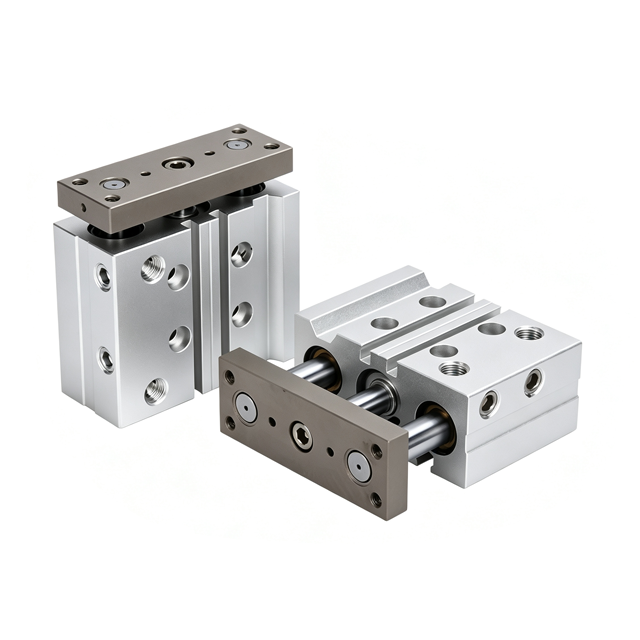
guided cylinder—also known as a three-shaft cylinder—is an integrated cylinder unit featuring three rigid guide shafts.

It consists of a piston rod, two parallel guide rods, a front flange, a cylinder barrel, a piston, and an optional magnetic ring.

As the piston moves, the two guide rods slide synchronously, providing resistance against rotation and off-center loads.

TCL TCM Series guide rod pneumatic cylinder 1

TCM/TCL Series Guided Cylinders

Zgodność z normami JIS

1. Complies with JIS standards;
2. Features two guide rods made of special bearing steel, guided by either linear ball bearings or brass sliding bearings, offering high resistance to torsional and lateral loads. Note: Linear ball bearings are suitable for lifting applications or scenarios requiring high precision and load capacity, particularly where low-friction movement is essential; brass sliding bearings are suitable for applications involving radial loads (such as braking), offering more than double the lateral impact resistance of standard brake cylinders and superior torsional rigidity;
3. The drive and guide units are integrated into a single body, eliminating the need for extra accessories and minimizing space requirements; selectable air ports allow for convenient installation;
4. Precision positioning holes are provided on the bottom and rear faces of the body as well as on the mounting plate (see the “PA” and “XX” holes in the dimensional drawing), enabling high-precision mounting for demanding applications;
5. Four sensor slots on the body accommodate various sensor mounting configurations;
6. The body’s unique design supports mounting and fixation from multiple directions.

Średnica otworu (średnica wewnętrzna w mm)610121620253240506380100
Rodzaj działaniaDwustronnego działania
Środek roboczyPowietrze (przefiltrowane przez filtr o wielkości porów 40 μm lub większej)
Temperatura roboczaod -20°C do +70°C
Zakres ciśnienia roboczego0,2–0,7 MPa0,15–1,0 MPa
Ciśnienie próbne1,2 MPa1,5 MPa
Zakres prędkości roboczej50–500 mm/s30–500 mm/s50–400 mm/s
AmortyzacjaPodkładka zapobiegająca zderzeniom
Non-rotating Accuracy (linear bearing)—±0.08°±0.07°±0.06°±0.05°±0.04°
Non-rotating Accuracy (sintered bushing)±0.1°±0.1°±0.09°±0.08°±0.06°±0.05°
Średnica trzpienia tłoka (mm)35681012161620202525
Wątek dotyczący portuM3×0,5M5×0,8M5×0,8PT1/8PT1/8PT1/8PT1/8PT1/8PT1/4PT1/4PT3/8PT3/8
TC Three-Axis Cylinder Order Code Generator

TC Three-Axis Cylinder Order Code Generator

Aktualny kod zamówienia:
TCM50×50S
Uwagi:
1. Series: TC three-axis cylinder (double acting). All series built with magnet (S).
2. Bearing: M = sintered bronze bushing; L = linear bearing (bore 6 / 10 not available for L).
3. Category: blank = standard; J = adjustable stroke.
4. Adjust stroke: only available with adjustable category (J); options 10 / 20 / 30 / 40 / 50 / 75 / 100 mm. No adjust stroke for bore 6 / 10.
5. Thread: blank = no code; PT = PT thread, G = G thread, T = NPT. When port thread is M5, this code is blank.
6. Sensors CMSG / DMSG / CS1-G available.
▲ W przypadku niestandardowych opcji lub szczególnych wymagań prosimy o kontakt z działem sprzedaży.

Guide Rod Cylinder Specifications

Tabela porównawcza różnic w doborze modeli

Three-Axis / Guide Cylinder Series

6 groups · 13 series · Click a group to expand · Click a series to view Type / Key Features / Cross-Replacement

Brak pasujących serii

Nazwy marek wymienione na tej stronie internetowej zostały podane wyłącznie w celach informacyjnych dotyczących norm technicznych. Produkt ten nie jest oryginalnym produktem danej marki i nie jest przez nią autoryzowany. Został wyprodukowany zgodnie ze specyfikacjami technicznymi danej marki i ma podobny wygląd; jest to jednak produkt opracowany niezależnie i nie ma żadnego związku z daną marką.

Najważniejsze cechy

Guide Rod Cylinder are widely used.

– Workpiece fixture lifting, clamping, and positioning
– Material transfer (vertical/horizontal) and pushing
– Robotic arm Z-axis lifting and compact pick-and-place mechanisms
– Limit and material-stopping mechanisms for automation equipment

Liniowy układ push-pull

Podnoszenie

Zacisk

Ogranicznik materiału

Przesuwanie materiału / Podawanie

Zastosowania cylindrów

Maszyny pakujące

Podajnik worków, głowica zgrzewająca, zasuwa leja, urządzenie do składania klap kartonowych, popychacz wyładowczy

Niestandardowa zautomatyzowana linia montażowa

Ustawianie i mocowanie elementów obrabianych, mechanizmy podnoszące służące do załadunku i rozładunku, mechanizmy zatrzymujące oraz wciskanie elementów.

Montaż samochodów

Ustawianie uchwytów spawalniczych, mocowanie obrabianych elementów oraz przenoszenie podzespołów

Urządzenia transportowe w logistyce

Urządzenia zatrzymujące na linii montażowej, popychacze sortujące oraz urządzenia do podnoszenia palet.

Maszyny ogólnego przeznaczenia

Otwieranie i zamykanie drzwi obrabiarki, podawanie obrabianego elementu oraz wyrzucanie odpadów.

Przemysł lekki i maszyny spożywcze

Płytka prowadząca przenośnika, proste urządzenie dociskowe (dostępna wersja ze stali nierdzewnej do środowisk wilgotnych)

Guide Rod Cylinder: Frequently Asked Questions

MYFEQD oferuje szeroki asortyment Cylinder prowadzący rozwiązania.

Nasze siłowniki pneumatyczne są zgodne z normami technicznymi wiodących światowych marek,

zapewnianie szybkich rozwiązań w zakresie doboru modeli w różnych gałęziach przemysłu

układy pneumatyczne.

What if the load point is far from the guide plate?

Longer lever arm proportionally increases the bending moment, causing rod wear, plate sag and vibration; oversize the bore if needed.

Yes, but rod deflection increases with the cube of stroke; follow the deflection curve and add support for long strokes.

Rubber bumpers absorb little energy; repeated impact loosens the plate, bends rods and shortens bearing life. Use external hydraulic shock absorbers at high speed.

Check thrust plus allowable moment; for offset loads or long guides, oversize the bore by 1–2 steps.

Normally the body is fixed while rods and plate extend; the plate can be fixed so the body moves in reverse, with the same thrust.

No. The piston rod is usually hard-chrome plated carbon steel for seal wear; guide rods are bearing steel or stainless steel, induction hardened for rigidity.

Bearings and guides are pre-greased; slight grease on first movement is normal—simply wipe it off.

Most use rubber bumpers; air cushioning is optional on some large/high-speed models and must be specified when ordering—it cannot be added later.

What are the tapped holes on the plate for?

For direct mounting of grippers, suction cups and fixtures; external-thread rod types use a rod-end nut instead.

No. Guide rods are locked by circlips and end covers; they only move linearly without rotation or torque transmission.

Air is compressible and seals have slight internal leakage under long-term load, which is normal; use a lock cylinder or mechanical stop where sinking is unacceptable.

It handles rated side forces and moments, but cannot replace a linear guide for continuous lateral dragging, which accelerates wear and loses accuracy.

Usually two (home + end); more can be added for multi-position detection, but the groove limits the minimum spacing.

Bumpers and covers have an energy limit; if mass × velocity² exceeds it, the cushion and cover will be damaged—speed adjustment alone is not enough.

High/low-temperature seals, FKM seals, dust boots, stainless guide rods, drop-prevention locks, air cushioning, custom strokes and special threads are available.

Block one port and supply air to the other; continuous leakage from the blocked or opposite port means worn piston seals. A brief exhaust sound only at switching is normal.

Logo MYFEQD NEW2

Wyślij nam wiadomość

Producenci urządzeń pneumatycznych w Chinach