– Uses only compressed air; eliminates the need for a hydraulic power unit, resulting in lower costs and simple installation.
– Delivers high output force with a compact footprint; smaller than a hydraulic cylinder for the same force output.
– Provides stable output with adjustable pressure and stroke.
– Operates quietly and carries a lower risk of oil leakage compared to standalone hydraulic systems.
20 years of experience in the manufacturing industry, delivering custom solutions tailored to your exact specifications and production requirements.
20+ Years ExperienceThe quality we deliver rivals that of major brands, as we strictly adhere to the technical standards of leading domestic and international labels.
ISO-Aligned QualityLocated in Liushi, Yueqing, Wenzhou, Zhejiang Province, China, our company boasts a comprehensive product component supply chain, advanced high-end equipment, and a long-standing manufacturing heritage.
Direct Factory PricingA booster cylinder (also known as a pneumatic-hydraulic booster cylinder or force-amplifying cylinder) is a force-amplifying actuator that combines pneumatic and hydraulic technologies;
it accepts low-pressure compressed air as input and outputs high-pressure hydraulic force,
requiring only an air supply and no hydraulic pump station.

1. Integrated design requiring only an air supply; eliminates the need for oil pumps, oil tanks, and hydraulic power units, simplifying installation.
2. Rapid approach to the workpiece with pre-pressure; automatic pressure intensification upon contact ensures a “soft landing” to protect the mold.
3. High output force; more compact than hydraulic cylinders of the same tonnage, with low noise operation.
4. Pressure is adjustable via an air pressure regulator; maintenance is simple.
| Item | Total Output (T) | ||||||||
|---|---|---|---|---|---|---|---|---|---|
| 1 | 3 | 5 | 10 | 13 | 15 | 20 | 30 | 40 | |
| Bore (mm) | 63 | 63 | 80 | 100 | 100 | 125 | 125 | 125 | 160 |
| Action Type | Double Acting | ||||||||
| Meio de trabalho | Air (filtered through 40μm) + ISO VG68 Oil, 2~7 kg/cm² | ||||||||
| Working Temperature | -5°C ~ +60°C | ||||||||
| Operating Speed | 50~700 mm/s | ||||||||
| Oil Cylinder Proof Pressure | 300 kg/cm² | ||||||||
| Air Cylinder Proof Pressure | 15 kg/cm² | ||||||||
| Operating Frequency | 20~30 cycles/min | 10 cycles/min | |||||||
| Piston Rod End Thread | M30×1.5 | M30×1.5 | M30×1.5 | M39×2 | M39×2 | M48×2 | M48×2 | M48×2 | M63×2 |
| Port Thread | G3/8 | G1/2 | |||||||
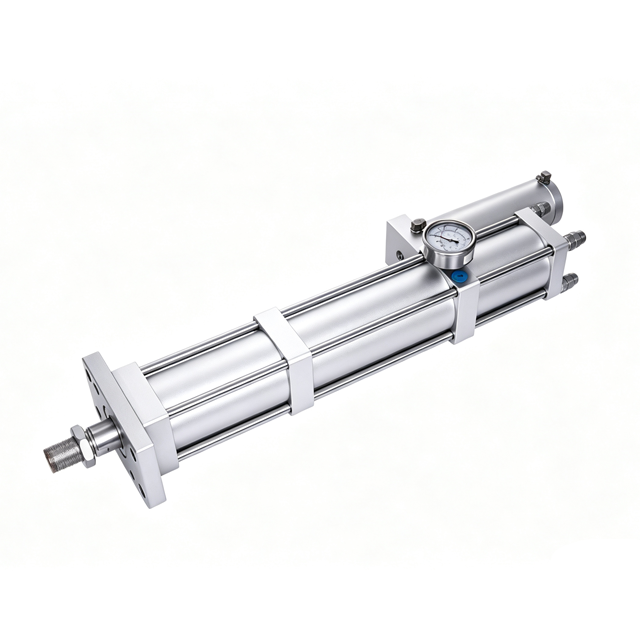
1. High-speed reciprocating motion; suitable for continuous operation with short cycle times on automated production lines.
2. Strict separation of oil and air minimizes bubble formation, ensuring more stable output and longer seal life.
3. Integrated design; supports standard vertical mounting (output force directed downward) as well as horizontal installation.
4. Pressure is adjustable via an air supply regulator; maintenance is simple.
| Item | Total Output (T) | ||||||||
|---|---|---|---|---|---|---|---|---|---|
| 1 | 3 | 5 | 10 | 13 | 15 | 20 | 30 | 40 | |
| Bore (mm) | 63 | 63 | 80 | 100 | 100 | 125 | 125 | 125 | 160 |
| Action Type | Double Acting | ||||||||
| Meio de trabalho | Air (filtered through 40μm) + ISO VG68 Oil, 2~7 kg/cm² | ||||||||
| Working Temperature | -5°C ~ +60°C | ||||||||
| Operating Speed | 50~1000 mm/s | ||||||||
| Oil Cylinder Proof Pressure | 300 kg/cm² | ||||||||
| Air Cylinder Proof Pressure | 15 kg/cm² | ||||||||
| Operating Frequency | 20~30 cycles/min | 10 cycles/min | |||||||
| Piston Rod End Thread | M30×1.5 | M30×1.5 | M30×1.5 | M39×2 | M39×2 | M48×2 | M48×2 | M48×2 | M63×2 |
| Port Thread | G3/8 | G1/2 | |||||||
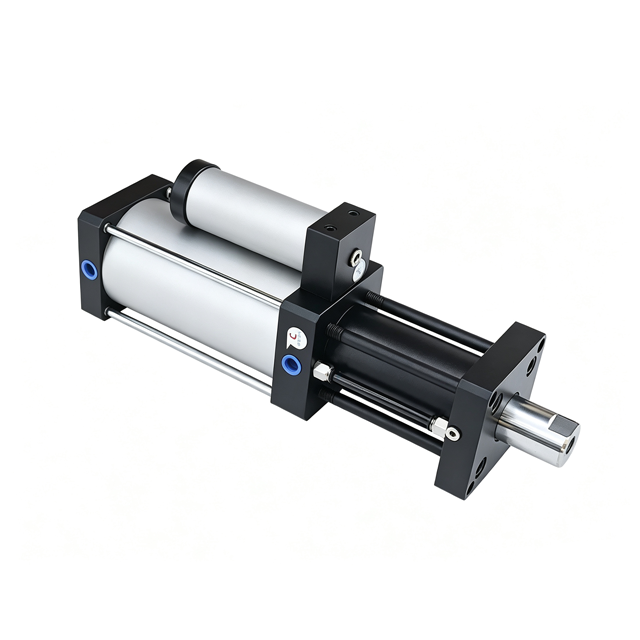
1. Maintains high-pressure thrust throughout the entire piston rod stroke; no need for workpiece contact to trigger pressure intensification.
2. Compact, integrated design allows for easy installation and eliminates the need for a hydraulic pump station.
3. Delivers stable output force; pressure can be adjusted via an air supply regulator.
4. Features a built-in pressure gauge port for direct pressure monitoring.
| Item | Total Output (T) | |||||
|---|---|---|---|---|---|---|
| 1 | 2 | 3 | 5 | 8 | 13 | |
| Bore (mm) | 50 | 50 | 50 | 50 | 80 | 80 |
| Action Type | Double Acting | |||||
| Meio de trabalho | Air (filtered through 40μm) + ISO VG32 Oil, 2~7 kg/cm² | |||||
| Working Temperature | -5°C ~ +60°C | |||||
| Operating Speed | 50~700 mm/s | |||||
| Oil Cylinder Proof Pressure | 300 kg/cm² | |||||
| Air Cylinder Proof Pressure | 15 kg/cm² | |||||
| Operating Frequency | ≥ 20 cycles/min | |||||
| Piston Rod End Thread | M16×2 | M16×2 | M16×2 | M30×1.5 | M30×1.5 | M39×2 |
| Port Thread | G1/4 | G1/4 | G1/4 | G1/4 | G3/8 | G1/2 |

1. Special sealing materials ensure the sealing performance of the hydraulic cylinder;
2. The hydraulic cylinder barrel undergoes special treatment, significantly enhancing wear and corrosion resistance;
3. Features a spindle air-blast function.
| Total Output at 0.6MPa | 3.5T | 4.5T | 6.0T |
|---|---|---|---|
| Action Type | Oil End: Single Acting Air End: Double Acting | ||
| Meio de trabalho | Air (filtered through 40μm) + ISO VG32 Oil, 2~7 kg/cm² | ||
| Working Temperature | -5°C ~ +60°C | ||
| Faixa de pressão de operação | 0.5~0.8 MPa | ||
| Air Cylinder Proof Pressure | 1.0 MPa | ||
| Port Thread | PT3/8 | PT3/8 | PT3/8 |
| No. | Series | Type | Key Features | Typical Application |
|---|---|---|---|---|
| 01 | MPT | Standard pre-press booster | Most common standard air-oil booster; faster than hydraulic, oil-level output; total stroke adjustable; leak-proof design; output 1T–40T; simple setup, easy maintenance, low noise | General press-fitting, punching, riveting, bending; electronics / automotive |
| 02 | MPTF | High-speed booster | Upgraded from MPT for speed; fast pre-press approach and quick boost response; high-cycle operation; for high-takt automation lines | High-frequency press-fitting, fast stamping, assembly lines |
| 03 | MPTC | Direct-press booster | Direct-pressure structure (no pre-press stroke, presses in one go); short stroke, high force; more compact body; for direct-force applications | Short-stroke press, riveting, punching |
| 04 | NPM | Compact booster | Compact mounting variant; same air-oil principle as MPT but smaller footprint; for space-constrained booster stations | Compact equipment, small press-fitting |
Brand names mentioned on this website are cited solely for reference regarding technical standards. This product is not an original product from the respective brand and is not authorized by that brand. It is manufactured in accordance with the corresponding brand’s technical specifications and features a similar appearance; however, it is an independently developed product and has no affiliation with the brand in question.
Suitable for stamping, press-fitting, riveting, punching,
bending, fixture clamping, and mold locking; widely used in automation equipment for applications such as bearing pressing,
plastic component pressing, and hardware riveting.
Bag feeding, sealing head, hopper gate, carton flap folding, discharge pusher
Workpiece positioning and clamping, lifting mechanisms for loading and unloading, stopping mechanisms, and component press-fitting.
Welding fixture positioning, workpiece clamping, and component transfer
Assembly line stoppers, sorting pushers, and pallet lifting units.
Machine tool door opening/closing, workpiece feeding, and scrap ejection.
Conveyor guide plate, simple hold-down device (stainless steel version available for humid environments)
MYFEQD offers a comprehensive range of Booster Cylinder solutions.
Our pneumatic actuators comply with the technical standards of major global brands,
providing quick solutions for model selection across various industrial
pneumatic systems.
No hydraulic power unit, pump or oil lines—high force from shop air, clean, energy-saving and low maintenance.
A pneumatic-hydraulic hybrid: air input, high-pressure oil output—a converter and amplifier.
Low-pressure fast approach saves time; high pressure engages only after contact, balancing speed and force.
Air drives the booster piston, compressing a sealed oil chamber; oil is incompressible, so pressure spikes.
Insufficient oil lets air enter the oil during stroke, causing unstable force, creeping and noise.
If oil runs out before the stroke ends, cavitation occurs; oil must cover the full stroke.
Complete air-oil separation prevents gas mixing, stabilizing force and avoiding cavitation/emulsification.
Output tonnage, total stroke and power stroke.
Pre-pressure is taller with two-stage structure; direct-pressure is shorter with one stage.
High-speed type, large-flow valve and air-oil separated design.
Fill to the gauge mark via the filler port and vent air initially.
Different ports/valves control them; boost triggers after contact.
Check supply pressure, internal leakage, low oil and valve leaks.
Dry hits release high force without a workpiece, shocking and damaging parts.
Damaged seals, overfilled oil, damaged barrel or oil through the valve.
Provide process, workpiece, tonnage, strokes and dimensions for the manufacturer to assist.

Fabricantes de equipamentos pneumáticos na China